
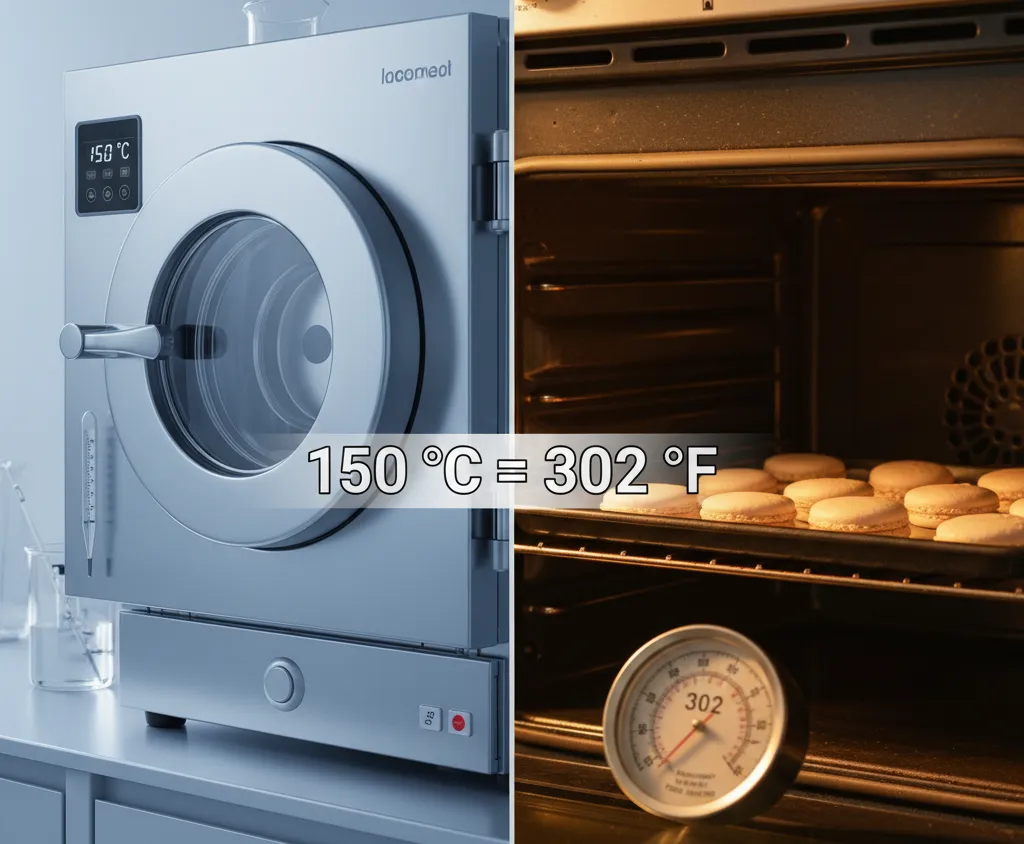
The global kitchen, laboratory, and workshop often require a swift, accurate leap between temperature scales. If you’ve ever stared at a foreign recipe calling for 150∘C or encountered technical specs in Celsius, you know the frustration. Your search for “150 C to F” signals a high-intent need for precision.
This temperature isn’t just a random number; it marks a crucial threshold in many delicate processes. In this guide, we’ll not only give you the exact conversion but also explore the practical significance of 150∘C and arm you with the fundamental knowledge to confidently navigate any temperature scale.
The Essential Conversion: 150∘C to ∘F
Let’s get straight to the point. When you convert 150 degrees Celsius to Fahrenheit, you get:
150∘C=302∘F
In practical terms, 302∘F is classified as a relatively low heat in most American ovens, a temperature that is perfect for gentle cooking and specialized material treatments.
The Conversion Formula, Step-by-Step
Understanding the formula removes the guesswork and gives you the power to convert any Celsius temperature. The relationship is based on the fact that the Fahrenheit scale has 180 degrees between the freezing and boiling points of water, while the Celsius scale has 100 degrees. This creates a 180/100, or 9/5 (1.8), ratio.
The standard formula for converting Celsius (TC) to Fahrenheit (TF) is:
TF=(TC×1.8)+32
Here is the precise calculation for 150∘C:
- Multiply by 1.8 (the ratio of the scale sizes): 150×1.8=270
- Add 32 (the freezing point offset): 270+32=302
The result is 302∘F.
Why 150 C to F Matters: Real-World Applications
Why do so many people search specifically for the conversion of 150∘C? Because this temperature zone is vital for achieving specific texture and material integrity that cannot be rushed.
Baking and Patisserie Perfection
In the delicate art of baking, 150∘C (or 302∘F) is often the temperature of patience and precision.
- Meringues: This low temperature is ideal for baking meringues and macaron shells. The low, consistent heat slowly dries out the egg white foam, allowing the exterior to form a crisp shell while minimizing browning. A higher temperature would cause the sugar to caramelize too quickly, resulting in a dark, brittle, or cracked surface.
- Slow Roasting Nuts and Seeds: Roasting nuts at 150∘C ensures an even, golden-brown toast that maximizes flavor without scorching the delicate oils. This is essential for achieving the perfect base for nut butters or brittle.
- Keep-Warm/Holding Temperature: For catering or family events, 302∘F can act as an excellent holding temperature to keep certain items warm and safe without actively cooking them further.
Industrial and Scientific Processes
Away from the oven, this conversion is critical in manufacturing and labs:
- Gentle Sterilization: While much higher temperatures are used in autoclaves, 150∘C is a sufficient temperature for dry heat sterilization of certain stable materials and is a common setting for drying equipment and glassware.
- Plastic Annealing: Many thermoplastics, like PLA (a common 3D printing filament), undergo a process called annealing at or near 150∘C to relieve internal stresses. This process makes the finished object stronger, more heat-resistant, and less brittle.
- Oven Testing and Curing: In materials science, 150∘C is a standardized temperature for testing the heat resistance of products or for curing specialized adhesives and coatings.
Quick-Check Conversions: Neighboring Temperatures
Since the accuracy of your oven or thermometer might vary, it’s helpful to know the conversions for the temperatures immediately surrounding 150∘C. This gives you a buffer for adjustments.
| Celsius (∘C) | Calculation: (TC×1.8)+32 | Fahrenheit (∘F) |
| 140 | (140×1.8)+32=284 | 284 |
| 145 | (145×1.8)+32=293 | 293 |
| 150 | (150×1.8)+32=302 | 302 |
| 155 | (155×1.8)+32=311 | 311 |
| 160 | (160×1.8)+32=320 | 320 |
The Power of Precision at 302 ∘F
Notice how a small 10∘C difference (from 150∘C to 160∘C) results in an 18∘F difference (from 302∘F to 320∘F). This magnification effect highlights why you must use the exact conversion formula, especially for critical applications. Using a rough estimate when dealing with temperatures near 150∘C can lead to significant errors in the Fahrenheit reading.
A Note on Estimation vs. Accuracy
While we’ve emphasized the need for precision, it’s worth noting the popular mental shortcut for quickly estimating Celsius to Fahrenheit in your head.
The “Double It and Add 30” rule:
TF≈(TC×2)+30
Let’s see how close this gets us for 150∘C:
(150×2)+30=300+30=330∘F
- Exact Answer: 302∘F
- Estimate: 330∘F
The 28∘F difference is substantial. While 330∘F might be perfectly acceptable for quickly checking the weather (e.g., is 20∘C hot or cold?), it is not suitable for baking, scientific testing, or any process where a 302∘F temperature point is the precise target.
When the stakes are high—whether it’s a perfect macaron or a durable industrial coating—always rely on 302∘F, the mathematically sound conversion for 150∘C to ∘F.
Easy Celsius to Fahrenheit Trick
Frequent Asked Questions
What is the precise conversion of 150 C to F?
The precise conversion of 150 degrees Celsius to Fahrenheit is 302°F. You can calculate this using the formula: (150×1.8) + 32 = 302∘F.
What is the mathematical formula used to convert Celsius to Fahrenheit?
The official formula to convert any Celsius temperature (TC) to Fahrenheit (TF) is: TF=(TC×1.8)+32. The factor of 1.8 represents the 9/5 ratio between the two temperature scales.
Why is 150°C (302°F) considered a significant temperature in cooking or science?
150°C is a significant temperature for ‘low-and-slow’ applications like baking delicate meringues and macaron shells, where the low heat prevents browning. Industrially, it is crucial for curing many polymers, adhesives, and coatings to ensure optimal strength and durability.